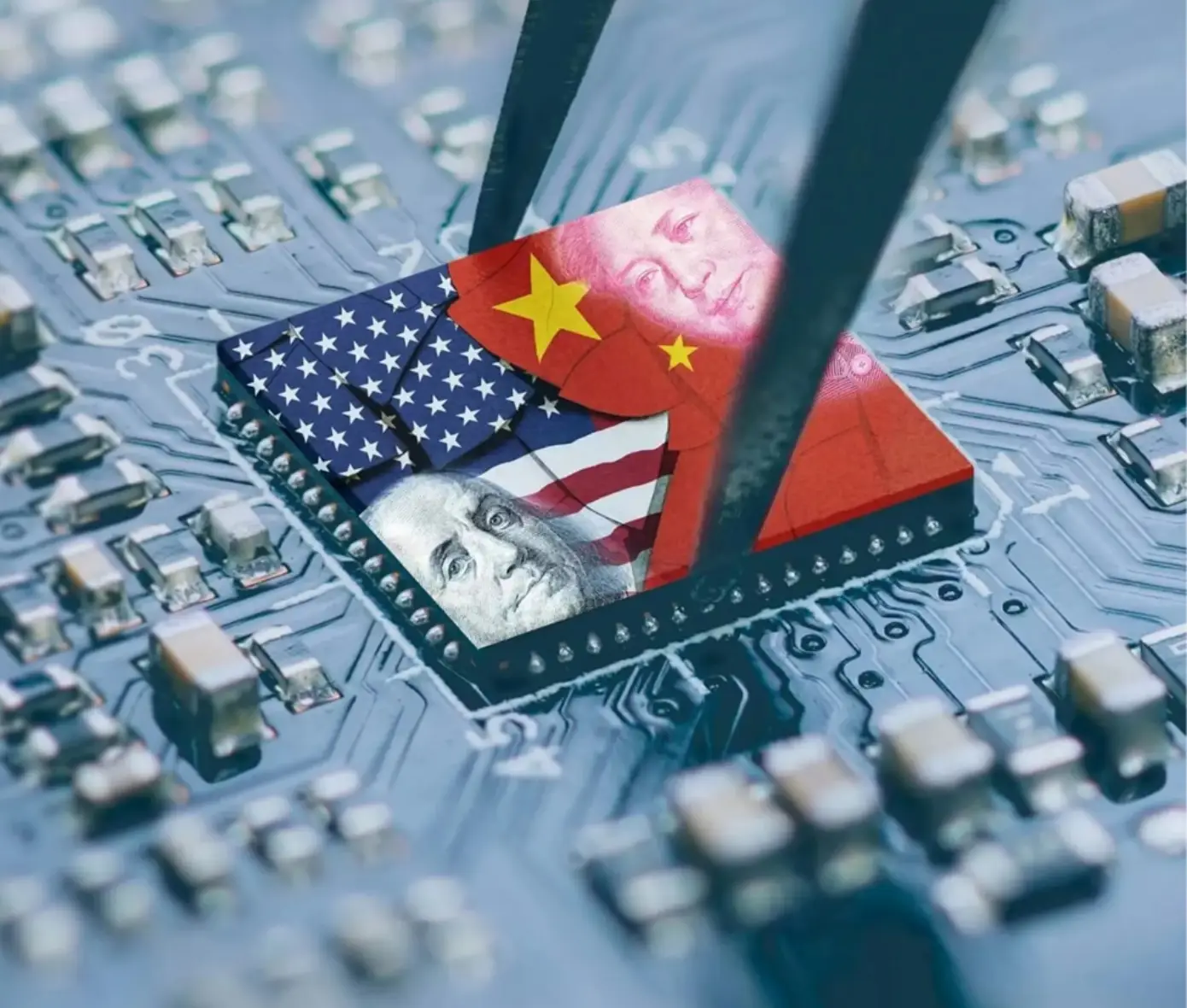

The United States has long been a leader in technological innovation, with Silicon Valley serving as a hub for AI research and development. American companies have pioneered influential AI models, maintaining a competitive edge in the global market. However, China’s “Next Generation Artificial Intelligence Development Plan,” launched in 2017, marked a strategic pivot. Through substantial investments and the proliferation of AI startups, China is rapidly closing the gap. Analysts like Professor Graham Allison and Eric Schmidt have noted China’s swift advancements, suggesting it may soon rival or surpass U.S. capabilities. The National Security Commission on Artificial Intelligence (NSCAI) highlights China’s growing share of top-cited AI research papers and significant investments in AI startups as indicators of its rising prowess.
A New Arms Race in Code
Artificial intelligence is no longer just an economic asset—it’s a pillar of national security. Both Washington and Beijing understand this, which is why they’re investing billions into AI development and integration. The United States still holds key advantages in foundational research, semiconductor design, and general-purpose AI. Yet China’s pace is relentless.
According to the National Security Commission on Artificial Intelligence (NSCAI), China has already surpassed the U.S. in several key metrics. Chinese researchers now publish more top-cited AI papers than their American counterparts. Industry studies suggest that nearly 47% of top AI researchers worldwide were born or educated in China, reflecting the significant contributions of Chinese scholars to the field. In 2022, China accounted for nearly 45% of the world’s most cited AI publications, while the U.S. made up around 35%.
Silicon Valley’s Strength and Strain
America’s edge has historically come from its decentralized, innovation-driven ecosystem. Companies like OpenAI, Google DeepMind, and Anthropic continue to set global benchmarks, with models like GPT-4 and Gemini leading the frontier in large language models (LLMs).
But maintaining this lead comes at a cost. Powering AI models at scale requires immense compute and energy. The Biden administration has committed over $50 billion to revitalize the domestic semiconductor industry, a foundational component of AI infrastructure. Still, experts caution that even this investment may fall short unless it’s paired with upgrades to the U.S. electric grid and energy capacity—both crucial for sustaining AI data centers.
China’s AI Trajectory: Innovation and Application
China’s approach to AI has evolved from emulating U.S. technological breakthroughs to focusing on practical applications that promise swift financial returns. The release of ChatGPT spurred the emergence of over 100 large language models (LLMs) in China within a year, many of which are adaptations of open-source frameworks like Llama. A significant development in China’s AI landscape is the rise of DeepSeek. Backed by the hedge fund High-Flyer, DeepSeek has developed the DeepSeek-R1 model, an open-source LLM that rivals leading Western models like OpenAI’s GPT-4. This trend reflects a broader strategy prioritizing rapid deployment over foundational innovation.
Two Systems, Two Visions
Where the U.S. promotes a private-sector-led model focused on innovation and market freedom, China’s AI ecosystem is deeply state-guided. Government funding, industrial planning, and regulatory coordination shape every layer of the Chinese AI pipeline.
This extends to military applications. Both nations are racing to develop AI-powered battlefield tools, from autonomous drones to predictive surveillance systems. The Pentagon’s AI strategy calls for “responsible autonomy” in defense systems, but details remain sparse. In China, military-civil fusion ensures that AI advances in industry can be rapidly translated to strategic uses.
According to a 2024 report by the Center for a New American Security, over 70% of Chinese AI startups have some form of government or military affiliation.
Regulatory Dilemmas
The divergence in ideology is perhaps most visible in regulation. While the European Union has adopted a risk-based framework under its AI Act, the U.S. continues to lean on a patchwork of sector-specific laws. A federal AI regulatory body has been proposed but not yet established.
In China, regulation is swift and top-down. New rules on generative AI require content alignment with “core socialist values”—placing ideological filters atop machine intelligence. Models like DeepSeek are subject to strict censorship, yet the company has also engaged in surprisingly open publication of model architecture and training details.
This regulatory mismatch complicates international diplomacy. U.S. allies like Japan and the Netherlands, who manufacture critical chipmaking equipment, have faced pressure to comply with U.S. export controls on China—leading to diplomatic strain and legal ambiguity.
Comparative Analysis: Strategies and Implications
The U.S. favors a market-driven, decentralized model fostering grassroots innovation, while China’s state-directed approach ensures coordinated efforts in AI research and development. These divergent strategies influence the pace and nature of AI advancements. Economically, the rivalry extends to trade negotiations and export controls, with both nations striving to secure critical infrastructure and talent. Regulatory frameworks also differ: the U.S. often adopts less stringent regulations to stimulate innovation, whereas China’s structured environment aligns technological progress with state objectives.
Toward a Global Reckoning
While the U.S.–China AI rivalry often reads like a zero-sum game, the stakes are broader than mere national competition. AI now influences climate models, drug discovery, educational systems, and digital governance. Missteps in its global management could have consequences beyond geopolitical maneuvering.
Many experts are calling for a “digital détente”—a framework for international cooperation on the safe and ethical deployment of frontier models. Yet with both nations increasingly framing AI development as a matter of sovereignty, such collaboration remains elusive.
“AI threat is like nuclear weapons,” said by Geoffrey Hinton, one of the “the Godfathers of AI.
What Comes Next
The next chapter in this race won’t be decided solely by breakthroughs in labs or the next viral chatbot. It will be shaped by regulatory vision, energy infrastructure, talent mobility, and perhaps most critically, political will.
For now, America’s lead is real—but not guaranteed. China’s momentum is undeniable. And the rest of the world is watching, caught between two models of technological governance, each with its own promises and perils.
As the race accelerates, the question is no longer who can lead in AI—but who should.

Arfa Khan is a researcher with an MPhil in American Studies from Quaid-i-Azam University, Islamabad. Her academic and professional expertise includes Artificial Intelligence, Sino–U.S. relations, and world politics, with a nuanced understanding of contemporary international dynamics and emerging technological paradigms.